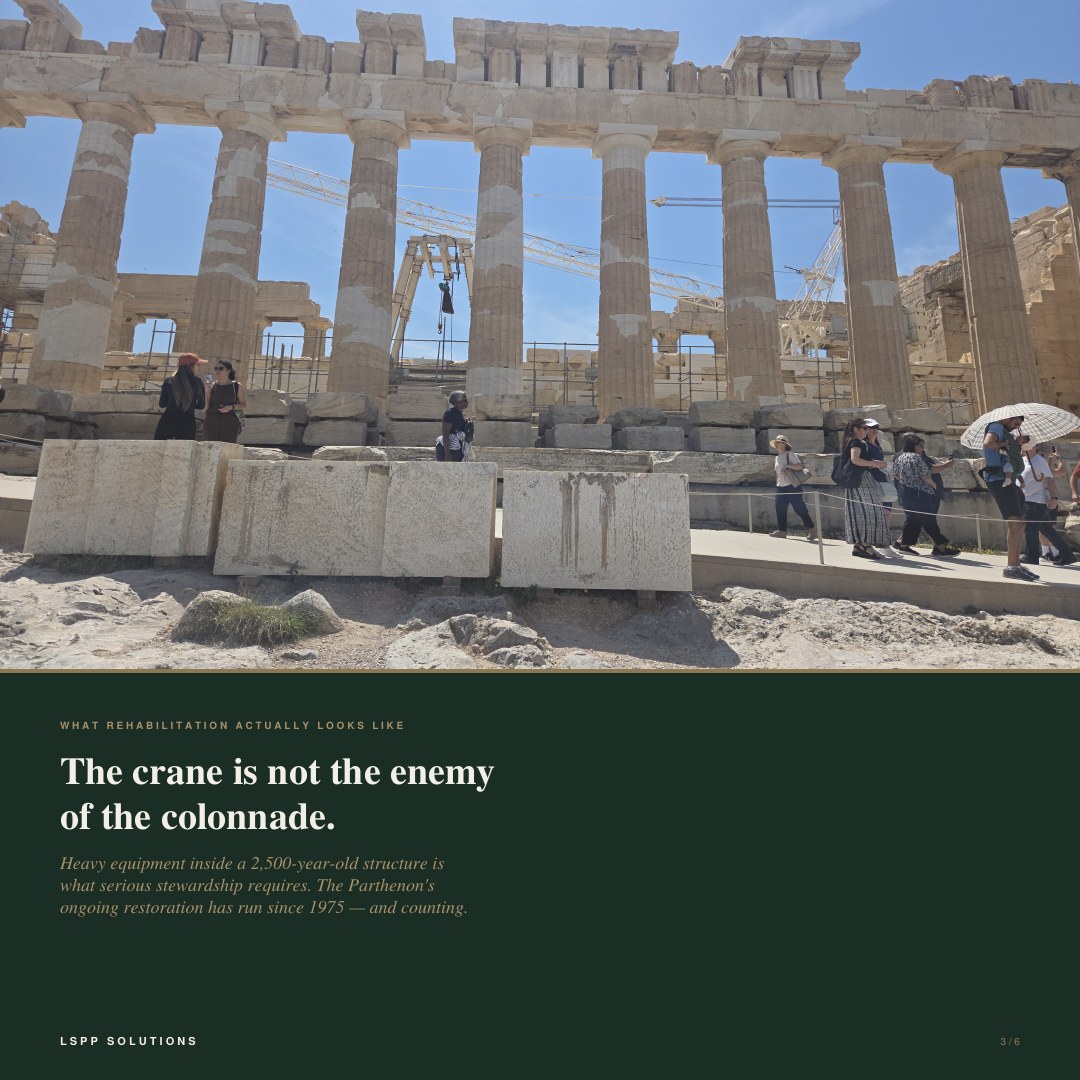
Athens is the longest-running construction project in human history. The Parthenon's restoration has been continuous since 1975 — fifty-one years of cranes, scaffolds, and decisions about what to save, what to replace, and what to leave honestly broken. The site is a working operations centre, not a finished monument. And it has been one for longer than any of us have been alive.
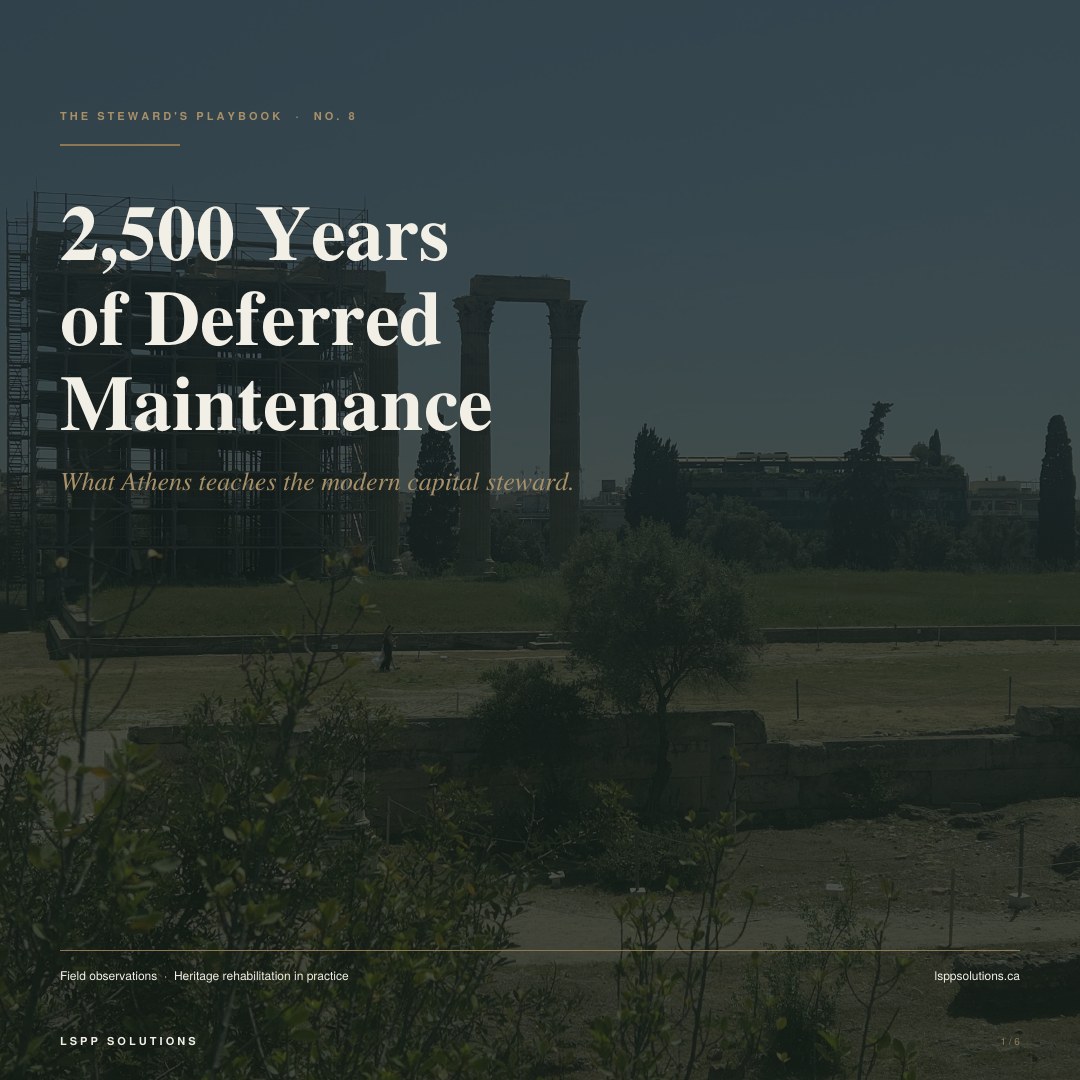
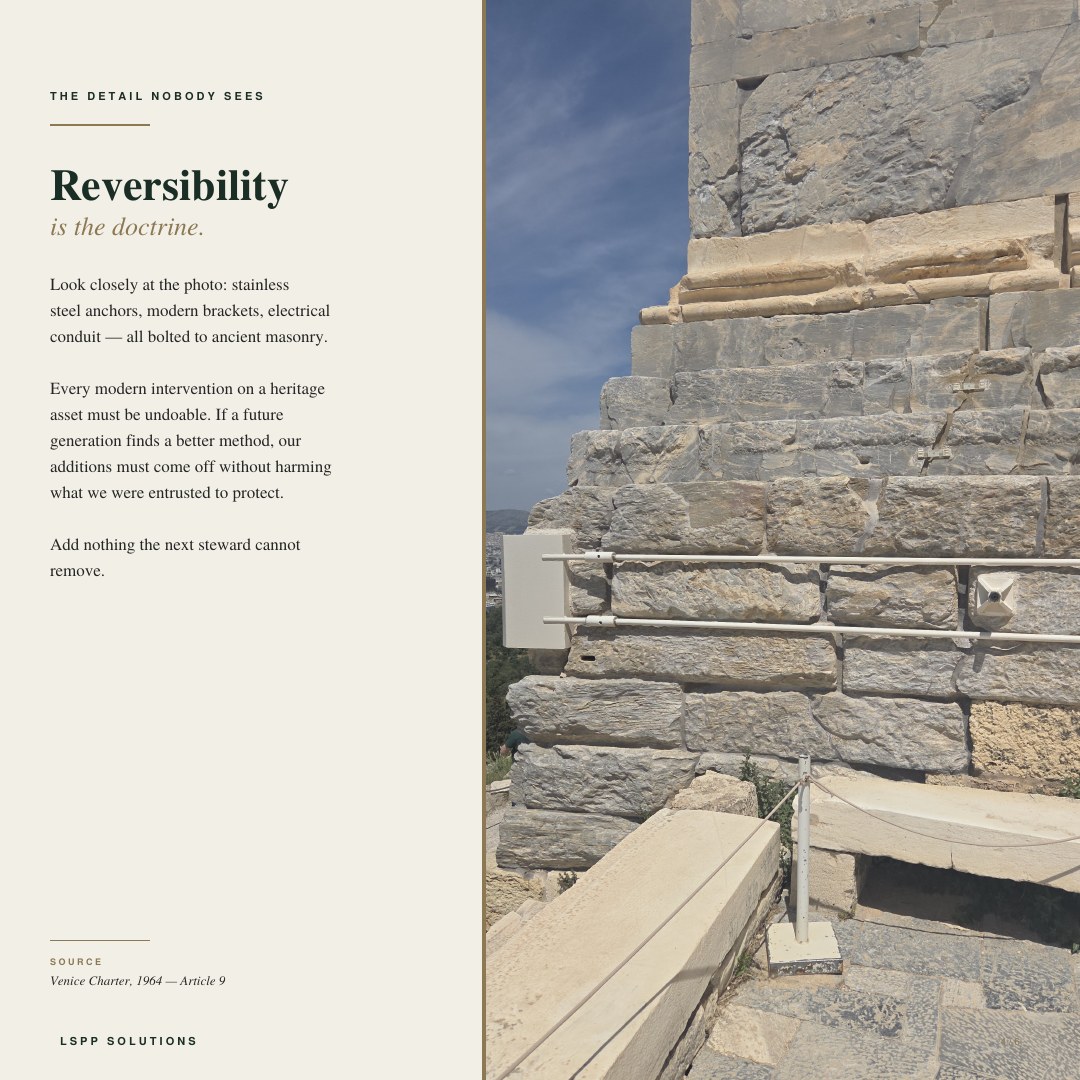
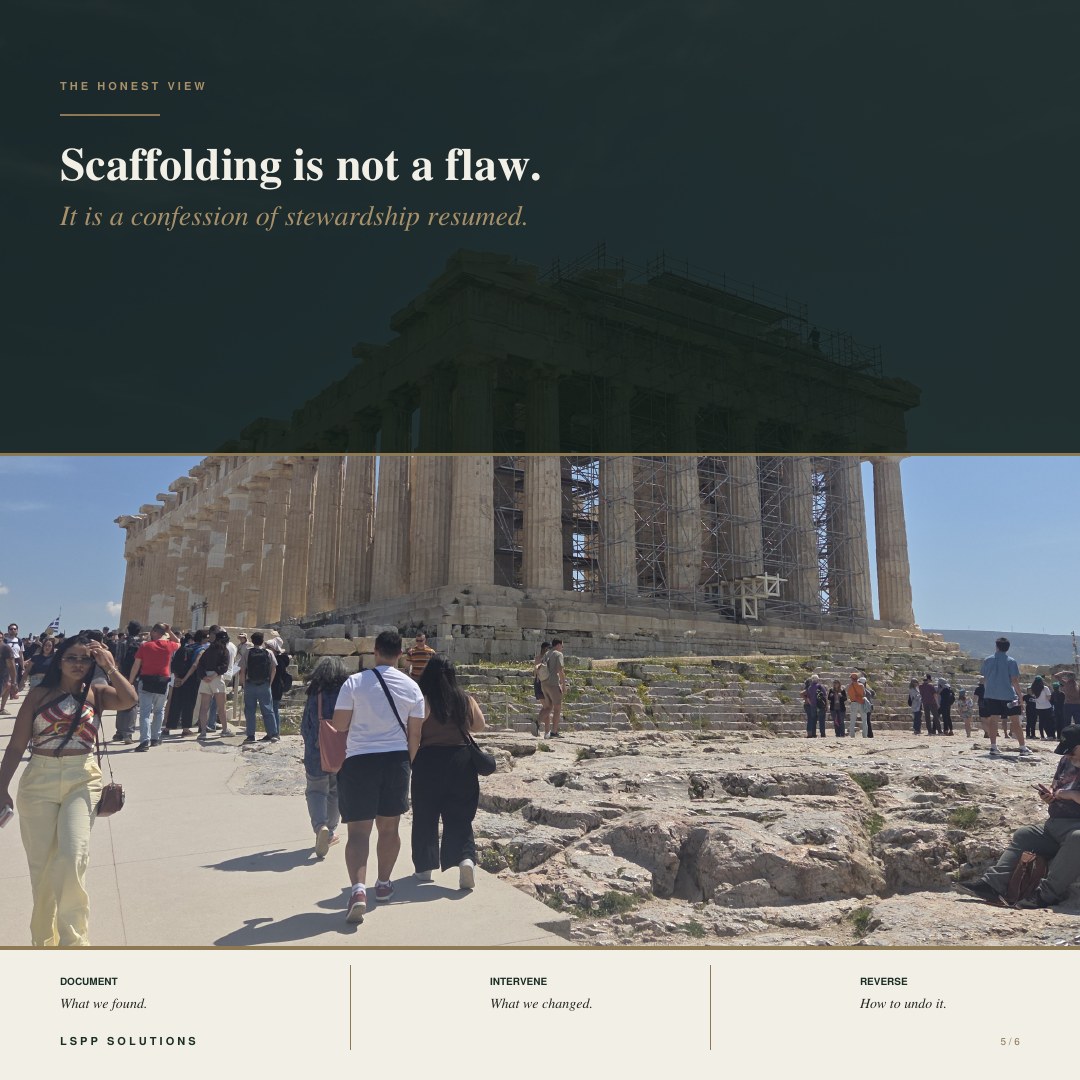
Stand on the Acropolis today and the ancient world is unmistakable. So is the modern infrastructure attached to it: stainless steel anchors threaded into the masonry. Electrical conduit running across two-thousand-year-old stone. A working crane parked between Doric columns. The Temple of Olympian Zeus has one column wrapped entirely in a steel scaffold cage, towering above the survivors that did not need help.
It is easy to look at this and feel a kind of melancholy. The Parthenon should be perfect. The columns should stand cleanly against the sky, untouched. Instead, the site looks busy — almost industrial. There is rebar. There are bolts. There are workers in hard hats.
But melancholy is the wrong response. The right response is recognition. What you are looking at is what serious stewardship actually looks like, executed at civilizational scale, sustained across half a century, by people who decided not to surrender the asset to time.
Field Observations from the Acropolis
Rehabilitation Is Not Romantic
Heritage work attracts a certain type of romanticism — the idea that old buildings are restored by careful hands using ancient methods, that preservation is a quiet, contemplative discipline. Some of that is true. Most of it is not.
Heritage rehabilitation in 2026 is engineering. It is project management. It is procurement. It is finance. It involves drilling into 2,500-year-old marble to install anchors that the original architect never imagined. It involves 3D scanning, dimensional surveys, mortar chemistry, structural reinforcement, and decisions about which fragments to reinstall and which to leave in the museum behind protective glass.
Above all, it involves money. The Acropolis Restoration Service has spent decades and tens of millions of euros on the work. The Parthenon project alone has consumed more capital — adjusted across fifty years — than most national heritage budgets see in a decade. And the work is not finished. It will not be finished in our lifetimes either.
The Canadian Parallel
Canada is not Athens. We do not have marble that has stood through Pericles, the Ottomans, and Lord Elgin. But we do have a federal heritage portfolio carrying its own quiet liabilities — Centre Block, the official residences, the wharves and lighthouses, the federal heritage stock managed by the FHBRO process — much of it operating under decades of deferred capital decisions.
The arithmetic is the same. Buildings age on a fixed schedule. Repair costs compound. Material specifications drift out of code. Skilled trades become harder to source. Every year a roof is not replaced, the cost of replacing it climbs faster than inflation. Every year a foundation is not stabilized, the eventual stabilization grows more invasive. Defer long enough, and the question stops being "how much will it cost?" and becomes "is the asset still recoverable?"
The Greeks have been working through this question for 2,500 years. They have made it their answer: keep the scaffolding up, keep the cranes running, and never pretend the work is done.
For capital stewards in 2026
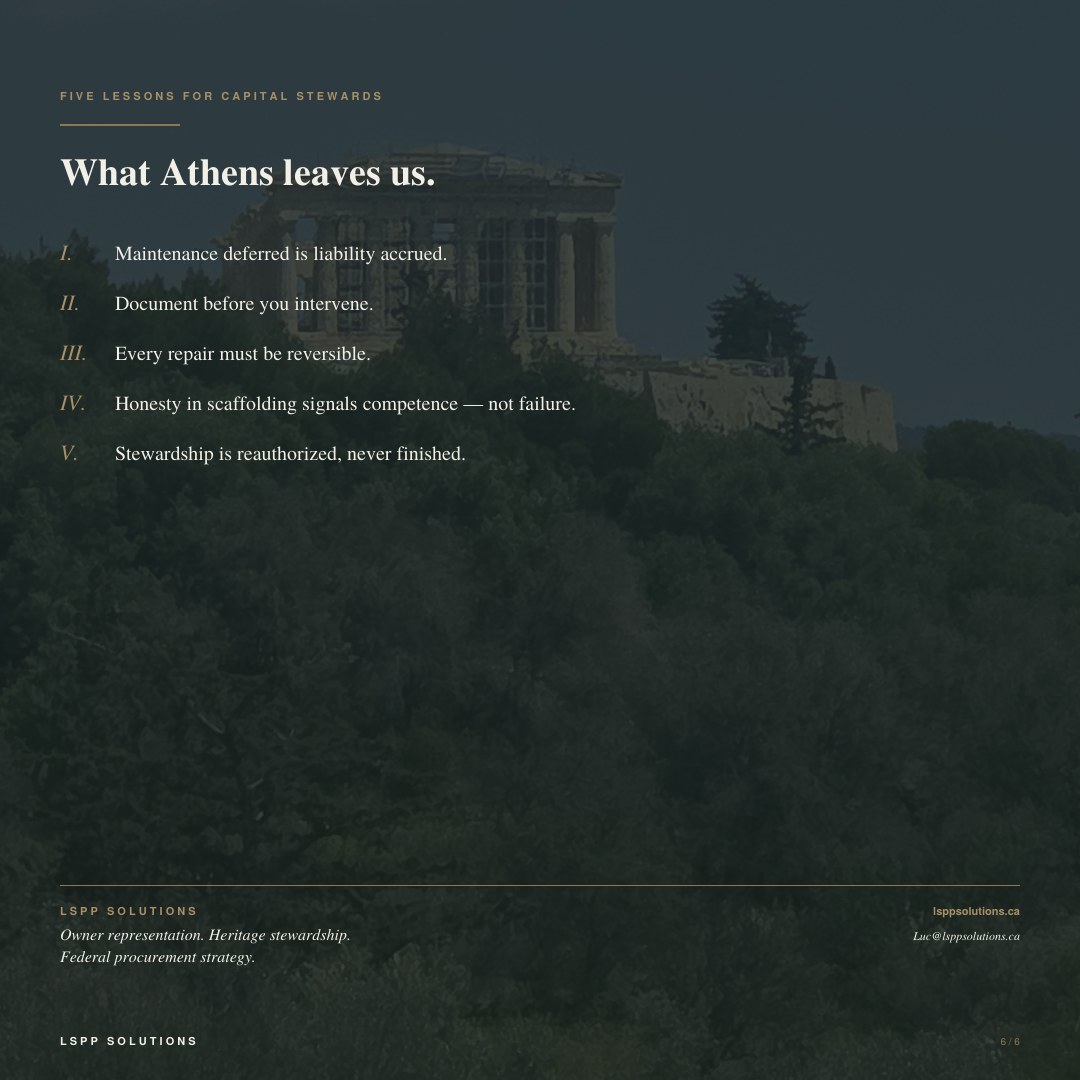
- Maintenance deferred is liability accrued. Every year of postponement increases the eventual bill. The compounding is not linear — it is exponential. Treat capital reserves as a non-discretionary line.
- Document before you intervene. The first act of stewardship is record-keeping. What you found, what was original, what was previous repair, what was never authorized. Without that record, the next steward cannot do their job.
- Every repair must be reversible. Add nothing the next steward cannot remove. Stainless steel anchors come out. Concrete infill does not. Methodology will improve in the next century — preserve the option to use it.
- Honest scaffolding signals competence, not failure. A heritage building wrapped in scaffold is a building under active care. The aesthetic discomfort is the price of serious work. Hide the work, and you hide the stewardship.
- Stewardship is reauthorized, never finished. No capital project on a heritage asset is ever truly complete. It is paused, handed off, picked up again. The discipline is generational. Plan accordingly.
The Steward's Duty
The buildings on Parliament Hill, the official residences in Ottawa, the federal heritage stock across the country — none of these are exempt from the arithmetic the Greeks have been working through since the fifth century BC. Maintenance is not optional. Reversibility is not an academic concern. Documentation is not a paperwork exercise.
An owner's representative on a heritage file does not just protect the budget. They protect the asset's future optionality. They make sure that what we do today does not foreclose on what the next generation can do tomorrow. That is what the Athens Charter, the Venice Charter, and the Burra Charter have been telling us for nearly a century, and what the Acropolis Restoration Service has been demonstrating in marble for fifty years.
The bill for stewardship comes due. The only choice is when, and to whom.
Carrying a heritage asset?
LSPP Solutions provides owner representation and financial stewardship for institutional and federal heritage portfolios.
Begin a Conversation